Showing posts with label UI. Show all posts

Saturday, August 22, 2026

eigengrau

Eigengrau is a near-black shade with subtle indigo and violet undertones. Because it sits at the edge of visibility, the hex code #16161d works better as a screen background than pure black, offering higher readability and less eye strain. It pairs effectively with soft, muted neons or stark whites. Designers favor this color for moody UI interfaces where a softer, more grounded alternative to absolute black is required.

source: https://colorkit.co/color/16161d/

Eigengrau is a German loanword used to describe the specific color of total darkness as perceived by human eyes. Rather than black, the color that human optic nerves discern in pure darkness is a dark gray. In German, eigengrau translates to “intrinsic gray”.

source: https://worddaily.com/words/eigengrau/

Saturday, April 12, 2025

Alarm Fatigue

Alarm fatigue or alert fatigue describes how busy workers become desensitized to safety alerts, and as a result ignore or fail to respond appropriately to such warnings. Alarm fatigue occurs in many fields, including construction and mining, healthcare, and the nuclear power field. Like crying wolf, such false alarms rob the critical alarms of the importance they deserve. Alarm management and policy are critical to prevent alarm fatigue. 

Examples

  • Vehicle back-up alarms sound so frequently that they often become senseless background noise
  • Electronic medical monitors tracking clinical information such as vital signs and blood glucose sound alarms so frequently, and often for such minor reasons, that they lose the urgency and attention-grabbing power which they are intended to have
  • California Proposition 65 has been criticized for causing "over-warning" due to encouraging "meaningless warnings." There is no penalty for posting an unnecessary warning sign, and to the extent that warnings are vague or overused, they may not communicate much information to the end user. Many companies now routinely attach Prop 65 warning labels to any product of theirs that they think might possibly contain one of the 900 listed chemicals without testing to see whether the chemical is really present in their product and without reformulating their product, because it is cheaper to do so than to run the risk of being sued by Prop 65 enforcers.

Proposed solutions

  • Identify by sound alone. Change alarm sounds to be softer and friendlier in order to improve identification of alarms. 
  • Adjust the parameters and delays to alarms to match the traits and status. However, this directly trades sensitivity for specificity.
  • Centrally monitor alarms where a trained person evaluates each alarm and distributes alerts only when necessary.
  • Adjust automated alarm algorithms to be more specific and not overly sensitive to mitigate false alarms and balance sensitivity and specificity to still detect actionable conditions.

See also

source: https://en.wikipedia.org/wiki/Alarm_fatigue

Wednesday, November 10, 2021

Dyslexia mode

Captured image of button to turn dyslexia mode on or off

Kudos to diginomica for providing dyslexia mode on their articles.

Following is an example from one of their articles with dyslexia mode OFF.

Example of text as displayed without dyslexia mode.

And that same paragraph with dyslexia mode ON.


Example of text with dyslexia mode

Friday, June 11, 2021

Flying Toasters

After Dark is a series of computer screensaver software introduced in 1989 for the Apple Macintosh, and in 1991 for Microsoft Windows.

The most famous of the included screensaver modules is the iconic Flying Toasters which featured 1940s-style chrome toasters sporting bird-like wings, flying across the screen with pieces of toast. Engineer Jack Eastman came up with the display after seeing a toaster in the kitchen during a late night programming session and imagining the addition of wings.

source: https://en.wikipedia.org/wiki/After_Dark_(software)
 

Saturday, May 29, 2021

Weber's Law of Just Noticeable Differences

Weber's Law states that the ratio of the increment threshold to the background intensity is a constant. So when you are in a noisy environment you must shout to be heard while a whisper works in a quiet room. And when you measure increment thresholds on various intensity backgrounds, the thresholds increase in proportion to the background. Weber's Law predicts a linear relationship between the increment threshold and the background intensity.

source: https://www.cis.rit.edu/people/faculty/montag/vandplite/pages/chap_3/ch3p1.html

Weber's Law (pronounced vay-ber) can be applied to variety of sensory modalities (brightness, loudness, mass, line length, etc.).  The size of the Weber fraction varies across modalities but in most cases tends to be a constant within a specific task modality.

source: http://apps.usd.edu/coglab/WebersLaw.html

It has been shown not to hold for extremes of stimulation.

source: https://www.britannica.com/science/Webers-law


Saturday, August 18, 2018

Low-code

A Low-code development platform (LCDPs) is software that provides an environment programmers use to create application software through graphical user interfaces and configuration instead of traditional computer programming. LCDPs trace their roots back to fourth-generation programming language (4GL) and rapid application development tools of the 1990s and early 2000s. Similar to these predecessor development environments, LCDPs are based on the principles of model-driven design, automatic code generation, and visual programming.

source: https://en.wikipedia.org/wiki/Low-code_development_platforms

In the software world, we rely on libraries, APIs and third-party infrastructure so that we can focus on delivering the unique bit of value that wouldn’t otherwise exist. But we still get bogged down. Our teams and roles have become ever more complex and specialized; even full-stack developers have their specialties. Self-professed full-stack developers responded that they specialized in C#, PHP, Java, Node.js or other niches. Then there are the DBAs, the test engineers, the Angular/React/Ember specialists. Much of the software we build follows similar patterns: many are CRUD applications at heart.

Low-code describes a family of tools that helps developers leap-frog all those specialized roles, skip the plumbing and re-implementation, and go straight to the unique 10%. Once you’ve seen these low-code tools in action, it’s not surprising that they’re often also called rapid application development platforms.

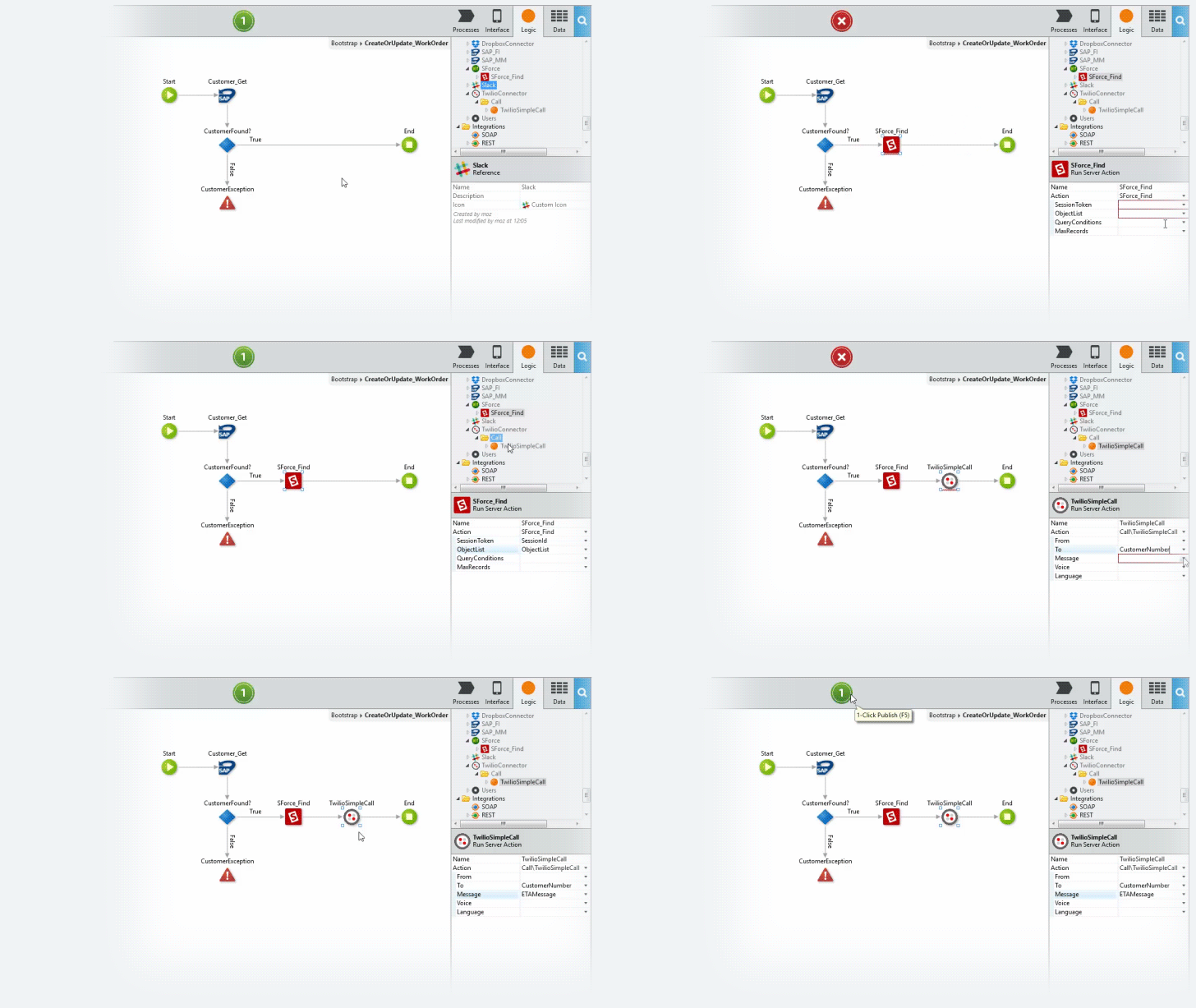
Here’s what a typical low-code platform looks like:
  • A visual IDE: An environment for visually defining the UIs, workflows and data models of your application and, where necessary, adding hand-written code.
  • A connector to one or more back-ends: automatically handles data models, storage and retrieval; think of it as an ORM on steroids.
  • Application lifecycle manager: Automated tools to build, debug, deploy and maintain the application in test, staging and production.
 
OutSystems
source: https://www.outsystems.com/blog/what-is-low-code.html

Low-code should not be confused with a low-level programming language. They are on opposite ends of the spectrum.

A low-level programming language is a programming language that provides little or no abstraction from a computer's instruction set architecture—commands or functions in the language map closely to processor instructions. Generally this refers to either machine code or assembly language. The word "low" refers to the small or nonexistent amount of abstraction between the language and machine language.

source: https://en.wikipedia.org/wiki/Low-level_programming_language

Saturday, August 11, 2018

elide

e·lide

tr.v. e·lid·ed, e·lid·ing, e·lides
  • To eliminate or leave out of consideration.
  • To cut short; abridge.
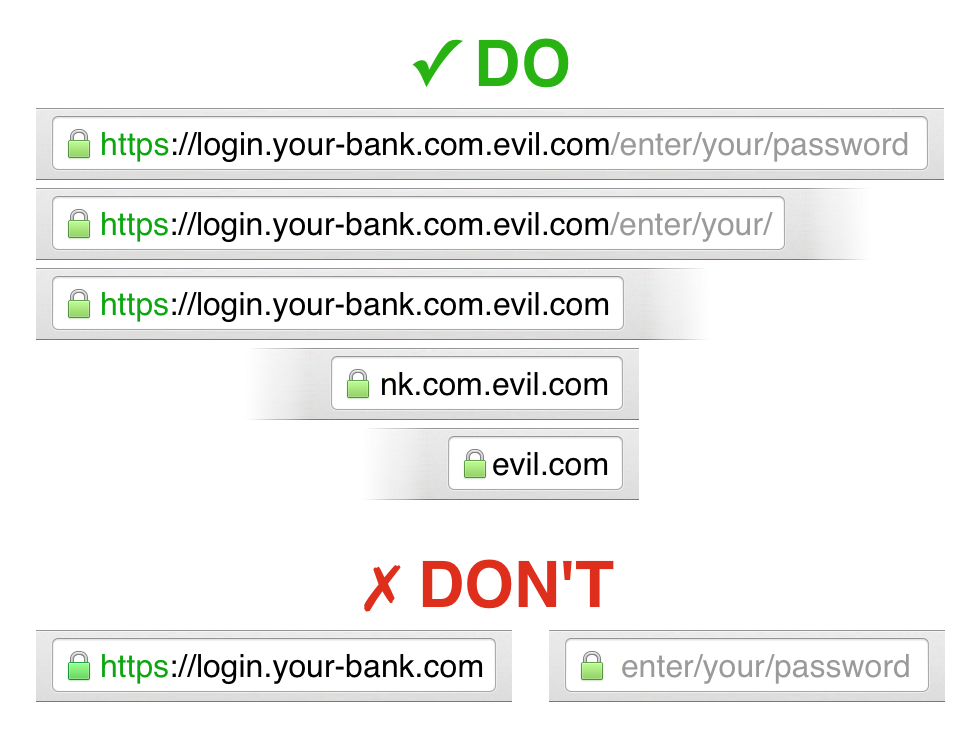
One example of eliding is the process of omitting parts of a URL (or origin) for simplicity or proper display. There are three main reasons to elide: simplicity, security, and space. Understand the importance of prioritizing the origin, and use visual cues to highlight the most important parts of the URL.
Eliding Origin Names And Hostnames

sources

https://www.thefreedictionary.com/eliding

Eliding: What It Is and Why It Matters

The Chromium Projects


Tuesday, July 21, 2015

Fitts’ Law (for UI design)


Why the hyperlink is above this text and the hyperlink is long rather than the short and obnoxious ‘here’ in click-here links.

"a descriptive model of human movement primarily used in human–computer interaction and ergonomics. This scientific law predicts that the time required to rapidly move to a target area is a function of the ratio between the distance to the target and the width of the target." ~ wikipedia

Thursday, September 5, 2013

treemap


Introduced by Ben Shneiderman in 1991, a treemap recursively subdivides area into rectangles. As with adjacency diagrams, the size of any node in the tree is quickly revealed. “Squarified” treemaps use approximately-square rectangles, which offer better readability and size estimation than naïve “slice-and-dice” subdivision.
- D3.js provides a treemap for data visualization.

Seen below, this treemap shows the whole contents of a directory tree on your Windows hard drive. The treemap represents each file as a colored rectangle, the area of which is proportional to the file's size. The rectangles are arranged in such a way, that directories again make up rectangles, which contain all their files and subdirectories. So their area is proportional to the size of the subtrees. The color of a rectangle indicates the type of the file, as shown in the extension list. The cushion shading additionally brings out the directory structure.
- http://windirstat.info/


Personal Note

Back in the late 80s, I read Shneiderman’s book Designing the User Interface, which had a profound effect on me. One rule I still remember is 7 ± 2 because people can generally store 5 – 9 things in their short term memory. In application, this means that menus should have between 5-9 items. More than 9 requires the user to waste extra time sorting through all the options.