Showing posts with label management. Show all posts

Saturday, August 29, 2026

Brandolini's law

Brandolini's law is an Internet adage coined in 2013 by Italian programmer Alberto Brandolini. It contrasts the considerable effort of debunking misinformation with the relative ease of creating it in the first place.

My thots: I've experienced many times when the latest information is accepted and replaced the old. This happens when the newest is trusted as a correction of the status quo. As the old proverb goes,

"The one who states his case first seems right, until the other comes and examines him." 

However, as the wikipedia article continues quoting others... 

In a 1710 article in The Examiner, Jonathan Swift said:

"Falsehood flies, and truth comes limping after it."

Variations on the adage, 

"A lie can travel halfway around the world before the truth can get its boots on." 

appeared in publication as early as 1820, when an article in the Portland Gazette stated that, 

"Falsehood will fly from Maine to Georgia, while truth is pulling her boots on."

In 1845, economist Frédéric Bastiat explained:

We must confess that our adversaries have a marked advantage over us in the discussion. In very few words they can announce a half-truth; and in order to demonstrate that it is incomplete, we are obliged to have recourse to long and dry dissertations.

source: https://en.wikipedia.org/wiki/Brandolini%27s_law

[ My thots:

Attempts to stop what is considered "disinformation" can result in the the Streisand effect.

The Streisand effect is the phenomenon in which an attempt to hide, remove, or censor information results in the unintended consequence of the effort instead increasing public awareness of the information.

At the bottom, the problem is one of trust and who decides what is "disinformation". The same evidence presented to different people can result in differences of opinion. Our believes tend to align with our community. A necessary short-cut to making decisions.

Suggested reading: The Righteous Mind by Jonathan Haidt

Permit me to pick at this example from wikipedia's article.

The persistent false claim that vaccines cause autism is sometimes cited as an example of Brandolini's law. In 1998, British anti-vaccine activist Andrew Wakefield wrote a fraudulent research paper which claimed to find a relationship between the MMR vaccine and autism. The article was retracted, and Wakefield's medical license was revoked. Despite extensive investigation showing no such relationship, the false assertion has had a disastrous effect on public health, contributing to vaccine hesitancy. Decades of research, and attempts to educate the public, have failed to eradicate the misinformation.

First, the author expresses their bias at the very beginning. "The persistent false claim..." This is a red flag warning that the evidence about to be presented is intended to align your opinion with the author's. The reader is not to arrive at their own conclusion, but to adopt the author's. The author continues to attempt to convince the reader using assertions: "wrote a fraudulent research paper". The author states "The article was retracted, and Wakefield's medical license was revoked.", which appears factual and is likely true. The unasked question is "Why?". Is it because the article truly was intentionally or negligently fraudulent or because of external pressure from vaccine producers (money) or political public health leaders (power) are trying to mitigate the "disastrous effect on public health"? The author ends that way they started, with an assertion of "misinformation" in spite of the concern parents have who have personally witnessed the correlation of the timing of vaccines with surfacing of autistic symptoms.

"The lady doth protest too much, methinks."

]

A related term is Gish gallop, a debate tactic where one person overwhelms an opponent with a rapid-fire stream of many weak, false, or misleading arguments. Because it takes much more time to disprove a claim than to make one, the opponent cannot answer everything in the time allowed.

The term "Gish gallop" was coined in 1994 by Eugenie Scott who named it after Duane Gish.

My thots: Sometimes the "galloper" is intentionally making weak, false, or misleading arguments in order to overwhelm their verbal opponent. Sometimes the "galloper" has weak thinking or logic or has based their arguments on misinformation given them. Lastly, and I think this is most common, both debaters stand on significantly different worldviews and fundamental principles and assumptions that even the meaning of the words are different resulting in each speaking past each other.

I've been taught the way to learn a topic is to listen to two people debate both sides of the topic. My experience of debaters with opposing perspectives don't understand the other's perspective and therefore cannot effectively shed light on the subject but, instead, generate heat and try to win allies and defeat their opponent. I'd rather listen to one moderate debate with himself because that person is interested in gaining a more accurate and deeper, nuanced understanding.

Related TWOTW articles


Saturday, July 18, 2026

SPACE framework metrics

The SPACE framework is a research-backed model for measuring software engineering productivity across five key dimensions: 

  • Satisfaction/well-being
  • Performance
  • Activity
  • Communication/collaboration
  • Efficiency/flow

Developed by researchers from Microsoft and GitHub, it avoids traditional output-only metrics in favor of a holistic approach.

The Five Dimensions of SPACE Metrics

S - Satisfaction and well-being: How developers feel about their work environment, team dynamics, and health. This is measured through surveys, burnout signals, eNPS, and retention rates.

P - Performance: The outcomes and impact of development efforts rather than just the code produced. Key indicators include customer-reported defects, service reliability, and change failure rates.

A - Activity: The volume or count of actions performed within the development process. It tracks commits, pull requests, code reviews, and build completions, though it should be balanced with other dimensions to prevent misleading output measurements.

C - Communication and collaboration: How teams work together and share knowledge. This evaluates the quality of code reviews, documentation, and the clarity of communication across distributed teams.

E - Efficiency and flow: The ability to complete tasks with minimal interruptions and delays. Measurements focus on cycle times, deployment frequency, focused development time, and the speed at which code is merged.

source: AI overview

Saturday, June 27, 2026

poka-yoke, forcing function

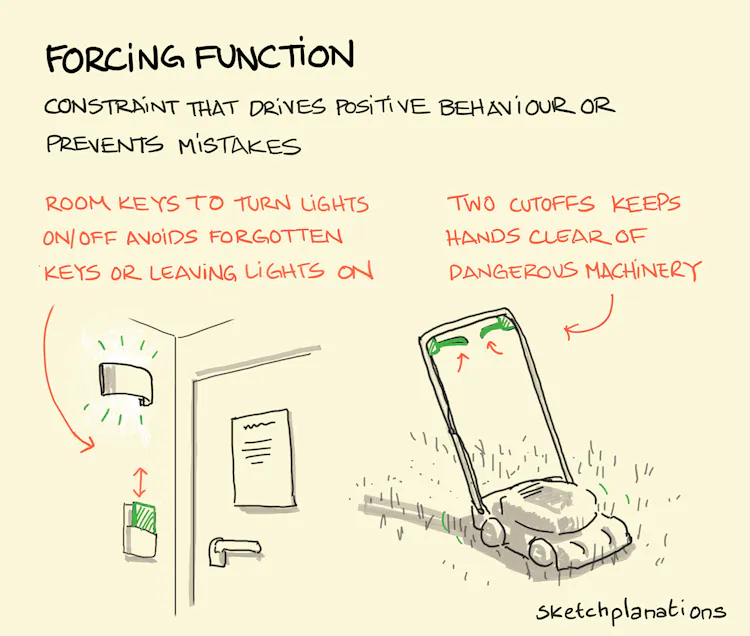
Poka-yoke is a Japanese term that means "mistake-proofing" or "error prevention", and is also sometimes referred to as a forcing function or a behavior-shaping constraint.

Defects occur when the human mistakes are allowed to reach the customer. The aim of poka-yoke is to design the process so that mistakes can be detected and corrected immediately, eliminating defects at the source.

Poka-yoke was originally baka-yoke, which means "fool-proofing" (or "idiot-proofing").

source: https://en.wikipedia.org/wiki/Poka-yoke

Forcing functions are a super way to help make things foolproof, or better, errorproof — as all of us make mistakes with designed things without being fools. You may have used your own forcing function when, in an attempt to make sure you remember your passport or tickets before a flight, you put them directly in front of the door so you couldn’t open it without noticing them.

source: https://sketchplanations.com/forcing-function

Saturday, May 23, 2026

takt time

Takt time is a calculation of the available production time divided by customer demand.

For example, if a widget factory operates 480 minutes per day and customers demand 240 widgets per day, takt time is two minutes. Similarly, if customers want two new products per month, takt time is two weeks. The purpose is to precisely match production with demand.

Takt is German for a precise interval of time such as a musical meter.

source: https://www.lean.org/lexicon-terms/takt-time/

Saturday, May 9, 2026

ROAM (risk management)

ROAM

ROAM is a risk management framework used primarily in Agile and Scaled Agile Framework (SAFe) to categorize risks during PI planning.

Resolved

The risk has been addressed and is no longer a concern.

Owned

A person has taken responsibility for addressing the risk/concern.

Accepted

The risk is considered absorbable if the situation occurs.

Mitigated

Action has been taken that lessens the probability of the event happening or the consequence if it happens has been reduced to acceptable limits.

Saturday, May 2, 2026

Sayre's Law

Sayre's law is an adage stating that "in any dispute the intensity of feeling is inversely proportional to the value of the stakes at issue." The principle underscores how conflicts over minor matters often generate outsized animosity due to the absence of significant material consequences.

Sayre, a professor of political science at Columbia University from 1952 until his death, drew from his experiences in university administration and faculty governance, where competition for prestige and minor perquisites often eclipsed substantive policy differences. The law underscores a pattern wherein low tangible risks permit unchecked escalation of ideological or interpersonal conflicts, unmitigated by external accountability or significant loss.

source: https://grokipedia.com/page/Sayre's_law

See also TWOTW: Bikeshedding

Saturday, April 18, 2026

YAGNI

YAGNI ("You Ain't Gonna Need It") is an Extreme Programming (XP) principle stating that functionality should only be added when it is actually needed, rather than when it is foreseen. It prevents overengineering and reduces technical debt by avoiding the creation of unnecessary, complex features that often go unused. 

source: AI overview of Wikipedia

Key Aspects of YAGNI:

  • Benefits: Reduces the cost of building, testing, and maintaining unnecessary code. It also minimizes the "cost of delay" for actual, needed features.
  • Application: It is commonly used in Agile development to maintain a clean codebase and focus on current, tangible value.
  • Drawbacks/Risks: If taken too far, it can lead to a lack of necessary architectural planning, making future refactoring difficult. It is not an excuse for ignoring security or essential design.

Example: Instead of building a complex, generic search algorithm for every conceivable scenario, you only implement the specific filtering required by the user right now. 

source: AI overview from martinfowler.com

When to Apply YAGNI:

  • When tempted to write "future-proof" code.
  • When features are proposed based on speculative, unverified future needs.
  • When complex abstractions are added prematurely. 

source: AI overview of Reddit


Saturday, April 11, 2026

eight wastes (lean): TIM WOODS

TIM WOODS

Transportation

Moving stuff or information more often or further than necessary

Inventory

Extra or unnecessary stuff or information; multiple versions

Motion

Poor ergonomics; poor layout; cruft; manual/repeated data entry

Waiting

Batch processing; insufficient training/staffing/processes/capacity

Overproduction

Extra stuff is created; poor forecasting; inappropriate performance measures

Over-processing

More is done than necessary; misunderstanding customer requirements or quality standards; providing too much detail

Defects

Rework; ineffective detection of process failures; poor training/design/documentation; incorrect/incomplete input data/information

Skills

Ineffective organizational management structure/culture; risk aversion; not using a person's skill; delegating to someone unskilled; staff blocked from their task (not empowered)

Saturday, April 4, 2026

SIPOC

A SIPOC diagram is a high-level process map that outlines the following:

  • Suppliers: The individuals, departments, or entities that provide the necessary inputs for the process.
  • Inputs: The resources, materials, or information required for the process to function properly.
  • Process: The series of steps or activities that transform the inputs into outputs.
  • Outputs: The end products, services, or deliverables generated by the process.
  • Customers: The recipients or beneficiaries of the outputs, whether internal or external to the organization

source: https://www.6sigma.us/process-mapping/sipoc-six-sigma/

Steps to create a SIPOCr diagram/chart.

  1. Process: list the 5-7 main steps of the process. Include when the process starts and ends.
  2. Outputs: list the outputs
  3. Customers: list the customer for each output
  4. Requirements: list the requirements for each output
  5. Input: list inputs required to run the process from start to finish
  6. Support: list who provides each input

Saturday, September 20, 2025

5S + 1 (process improvement)

  1. Sort - remove unneeded item from the immediate workspace
  2. Straighten or set in order - position items strategically in their place
  3. Shine or sweep - clean the area
  4. Standardize - make the first 3 S's part of daily activity
  5. Sustain or self-discipline - accountability, audit, and maintain
  6. Safety - periodic audits for a safe environment

source: https://www.linkedin.com/learning/lean-six-sigma-analyze-improve-and-control-tools/5s

Saturday, August 23, 2025

monotropism

Monotropism is an individual's tendency to focus their attention on a small or singular number of interests at any time, with them neglecting or not perceiving lesser interests. 

The word mono ("one, single") here is chosen in contrast to poly ("many"); whereas -tropism points to "directional movement or growth".

A tendency to focus attention tightly can be seen as a state of "tunnel vision". While monotropism tends to cause people to miss things outside their attention tunnel, within it, their focused attention can lend itself to intense experiences, deep thinking, and more specifically, flow states. However, this form of hyperfocus makes it harder to redirect attention, including starting and stopping tasks.

source: https://en.wikipedia.org/wiki/Monotropism

Saturday, June 21, 2025

Personality type schemas

Myers-Briggs

The Myers-Briggs® system consists of four preference pairs that reflect different aspects of personality—opposite ways to direct and receive energy through Extraversion (E) or Introversion (I), take in information with Sensing (S) or Intuition (N), come to conclusions using Thinking (T) or Feeling (F), and approach the outside world through Judging (J) or Perceiving (P). 

ISTJ

Quiet, serious, earn success by being thorough and dependable. Practical, matter-of-fact, realistic, and responsible. Decide logically what should be done and work toward it steadily, regardless of distractions. Take pleasure in making everything orderly and organized—their work, their home, their life. Value traditions and loyalty.

ISFJ

Quiet, friendly, responsible, and conscientious. Committed and steady in meeting their obligations. Thorough, painstaking, and accurate. Loyal, considerate, notice and remember specifics about people who are important to them, concerned with how others feel. Strive to create an orderly and harmonious environment at work and at home.

INFJ

Seek meaning and connection in ideas, relationships, and material possessions. Want to understand what motivates people and are insightful about others. Conscientious and committed to their firm values. Develop a clear vision about how best to serve the common good. Organized and decisive in implementing their vision.

INTJ

Have original minds and great drive for implementing their ideas and achieving their goals. Quickly see patterns in external events and develop long-range explanatory perspectives. When committed, organize a job and carry it through. Skeptical and independent, have high standards of competence and performance—for themselves and others.

ISTP

Tolerant and flexible, quiet observers until a problem appears, then act quickly to find workable solutions. Analyze what makes things work and readily get through large amounts of data to isolate the core of practical problems. Interested in cause and effect, organize facts using logical principles, value efficiency.

ISFP

Quiet, friendly, sensitive, and kind. Enjoy the present moment, what's going on around them. Like to have their own space and to work within their own time frame. Loyal and committed to their values and to people who are important to them. Dislike disagreements and conflicts; don't force their opinions or values on others.

INFP

Idealistic, loyal to their values and to people who are important to them. Want to live a life that is congruent with their values. Curious, quick to see possibilities, can be catalysts for implementing ideas. Seek to understand people and to help them fulfill their potential. Adaptable, flexible, and accepting unless a value is threatened.

INTP

Seek to develop logical explanations for everything that interests them. Theoretical and abstract, interested more in ideas than in social interaction. Quiet, contained, flexible, and adaptable. Have unusual ability to focus in depth to solve problems in their area of interest. Skeptical, sometimes critical, always analytical.

ESTP

Flexible and tolerant, take a pragmatic approach focused on immediate results. Bored by theories and conceptual explanations; want to act energetically to solve the problem. Focus on the here and now, spontaneous, enjoy each moment they can be active with others. Enjoy material comforts and style. Learn best through doing.

ESFP

Outgoing, friendly, and accepting. Exuberant lovers of life, people, and material comforts. Enjoy working with others to make things happen. Bring common sense and a realistic approach to their work and make work fun. Flexible and spontaneous, adapt readily to new people and environments. Learn best by trying a new skill with other people.

ENFP

Warmly enthusiastic and imaginative. See life as full of possibilities. Make connections between events and information very quickly, and confidently proceed based on the patterns they see. Want a lot of affirmation from others, and readily give appreciation and support. Spontaneous and flexible, often rely on their ability to improvise and their verbal fluency.

ENTP

Quick, ingenious, stimulating, alert, and outspoken. Resourceful in solving new and challenging problems. Adept at generating conceptual possibilities and then analyzing them strategically. Good at reading other people. Bored by routine, will seldom do the same thing the same way, apt to turn to one new interest after another.

ESTJ

Practical, realistic, matter-of-fact. Decisive, quickly move to implement decisions. Organize projects and people to get things done, focus on getting results in the most efficient way possible. Take care of routine details. Have a clear set of logical standards, systematically follow them and want others to also. Forceful in implementing their plans.

ESFJ

Warmhearted, conscientious, and cooperative. Want harmony in their environment, work with determination to establish it. Like to work with others to complete tasks accurately and on time. Loyal, follow through even in small matters. Notice what others need in their day-to-day lives and try to provide it. Want to be appreciated for who they are and for what they contribute.

ENFJ

Warm, empathetic, responsive, and responsible. Highly attuned to the emotions, needs, and motivations of others. Find potential in everyone, want to help others fulfill their potential. May act as catalysts for individual and group growth. Loyal, responsive to praise and criticism. Sociable, facilitate others in a group, and provide inspiring leadership.

ENTJ

Frank, decisive, assume leadership readily. Quickly see illogical and inefficient procedures and policies, develop and implement comprehensive systems to solve organizational problems. Enjoy long-term planning and goal setting. Usually well informed, well read, enjoy expanding their knowledge and passing it on to others. Forceful in presenting their ideas.

source: https://www.myersbriggs.org/my-mbti-personality-type/the-16-mbti-personality-types/

Love Languages

This model identifies five primary ways people express and receive love: 

  1. words of affirmation
  2. quality time
  3. acts of service
  4. gifts
  5. physical touch

Big 5 Personality Traits

A person scores high to low on a continuum for each of these five primary traits.
OCEAN (openness, conscientiousness, extraversion, agreeableness, and neuroticism)

Openness

Openness emphasizes imagination and insight the most out of all five personality traits. People who are high in openness tend to have a broad range of interests. They are curious about the world and other people and are eager to learn new things and enjoy new experiences. People who are high in this personality trait also tend to be more adventurous and creative. 

Conversely, people low in this personality trait are often much more traditional and may struggle with abstract thinking.

Conscientiousness

Conscientiousness is defined by high levels of thoughtfulness, good impulse control, and goal-directed behaviors. Highly conscientious people tend to be organized and mindful of details. They plan ahead, consider how their behavior affects others, and are conscious of deadlines.

If a person scores low on this personality trait, it might mean they are less structured and organized. They may procrastinate when it comes to getting things done, sometimes missing deadlines completely.

Extraversion 

Extraversion (or extroversion) is a personality trait characterized by excitability, sociability, talkativeness, assertiveness, and high amounts of emotional expressiveness. People high in extraversion are outgoing and tend to gain energy in social situations. Being around others helps them feel energized and excited.

People who are low in this personality trait (or introverted) tend to be more reserved. They have less energy in social settings, and social events can feel draining. Introverts often require a period of solitude and quiet to "recharge."

Agreeableness

Agreeableness includes attributes such as trust, altruism, kindness, affection, and other prosocial behaviors. People who are high in agreeableness tend to be more cooperative.

Those low in this personality trait tend to be more competitive and sometimes even manipulative.

Neuroticism 

Neuroticism is a personality trait characterized by sadness, moodiness, and emotional instability. This trait is generally defined as a negative personality trait that can have detrimental effects on a person's life and well-being. Individuals who are high in neuroticism tend to experience mood swings, anxiety, irritability, and sadness.

People who are low in this personality trait tend to be more stable and emotionally resilient.


source: https://www.verywellmind.com/the-big-five-personality-dimensions-2795422

Nine Enneagram Types

Decision-Making Styles Of The Enneagram Types

The decision-making process varies depending on the personality types at work. However, each enneagram type can be categorized as making decisions through their head, heart, or gut.

Going With Your Gut

Personalities that go with their gut tend to be instinctive. They want to be in control and have authority, respect, and power. “Personalities in this category really don't like to be told what to do,” said Copley, “which has a clear implication for team decision-making.” This workplace personality likes to be in charge because they like to make decisions, and they're good at it. But to put it bluntly, they're often also control freaks.

Reformer

The Reformer is driven by perfection and the desire for personal growth. They expect themselves and others to be their best at all times. But under stress, they start nitpicking. They don't like to decide with incomplete information, and their quest for perfection causes damaging delays.

Challenger

The Challenger is strong and action-oriented. The good news is that you have a lot of forward momentum and are energized by vibrant debate. You are confident and decisive. However, in stressful times you may move so fast that you don't get proper input from others. This fast pace may result in you misinterpreting silence as agreement and running right over less forceful dissenters.

Peacemaker

If you are a Peacemaker, you crave control because you want to ensure that everyone is happy. You bring people together, and synthesize perspectives across the team. But when stressed, you can be so hyper-focused on harmony that you may avoid conflict, gloss over important disagreements and make the wrong decision just to keep everyone happy.

Straight From The Heart  

Of all the personality types at work, the heart types are the most driven by how other people perceive them. “They care about what people see in them, and what impressions their decisions will make on other people,” said Copley. The good news is that this need for validation drives a quest for achievement and a desire for feedback. The bad news is that heart types can be driven by appearances instead of results.

Helper

The Helper is extremely tuned into the morale of an organization. You are that bright-eyed co-worker who is always making direct, warm eye contact and involving everyone. The Helper knows how to read people and has high emotional intelligence. This is great, except when you are a leader who needs to make a decision that will affect people negatively. Preferring to be liked, you'd rather avoid hard but necessary decisions.

Achiever

The Achiever is also focused on other team members, but you are also looking for admiration. You are self-confident and extremely success-oriented. This makes you methodical in decision-making, because you want to win. But you run into trouble when a decision reflects badly on you - you hide the bad news or distance yourself from the problems.

Individualist

The Individualist tends to be highly creative, with a deep appreciation for beauty and aesthetics. They tend to be introspective with high levels of self-awareness. You like to work alone to design elegant solutions. You love to say, “I think there is a totally different way to look at this.” This is highly valuable for a team, but under stress you may disrupt discussion with a disdain for the mundane, demanding elegance over all else. This may make you appear self-absorbed.

It's All in Your Head

The head triad is driven by their focus on what is going to happen in the future. “They want to get things moving towards a better tomorrow," said Copley. They are always playing out future scenarios in their heads and want to be ready for what's coming one, two or ten steps ahead. But they can also ignore the here and now, becoming overly confident that their vision of the future is real.

Investigator

Investigators play out mental scenarios and like to have a ton of data. Characteristically, you are the person on the team who will read not just the full report but the footnotes and references, too. You are highly analytical, objective and rational, but when stressed you get too hung up on research to make a decision, and have a blind spot for important emotional factors.

Loyalist

The Loyalist thinks a lot about security and wants to know that the future will be OK. You have a lot of skepticism and you squelch this by working through scenarios extremely carefully (especially worst-case scenarios). You are a clairvoyant planner and very loyal, but your focus on obstacles can cause your team to dismiss your worries and miss your insights.

Enthusiast

The fun-loving Enthusiast is all about finding joy in life and work. Their optimistic energy is contagious. Always bold and innovative, their peers would describe them as agents of change. They're a quick study and see opportunity everywhere. But Enthusiasts often struggle to meet deadlines. Additionally, under stress they blow off objections and shrug off problems, believing things will work out even when they probably won't.

source: https://www.cloverpop.com/blog/personality-types-at-work

Hippocrates' Four Temperaments

This ancient theory divides personalities into four types, associated with different body fluids. 

  • choleric
  • melancholic
  • phlegmatic
  • sanguine 

The Hire Success® System builds on this historical foundation, with the belief that each person is a unique combination of all four personality types. It gives the four types a simple A-D nomenclature to avoid assigning descriptive labels to people
source: https://www.hiresuccess.com/help/understanding-the-4-personality-types


DISC Personality Types


D: Dominance

A person with a D style is an ambitious go-getter who loves to take on challenges and achieve results. They’re direct, determined, assertive, driven and self-confident – but can sometimes be too quick to act or overlook the needs of others.

I: Influence

A person with an I style is sociable, and motivated by recognition, relationships and fun. They are eager to network, express enthusiasm, and work well collaboratively. These individuals tend to be quite charming and persuasive – however they may lack follow-through at times, due their impulsiveness or lack of structure.

S: Steadiness

A person with an S style is all about building relationships, supporting others, and maintaining stability. They are fiercely loyal, reliable, and driven by cooperation rather than competition. However, because they tend to be slower paced, they can resist change or making quick decisions.

C: Conscientiousness

A person with a C style is the ultimate perfectionist, taking their time to make sure everything is up to the highest standards of quality. They have an impressive attention for detail and a thirst for knowledge and accuracy; however, they can get bogged down by overly analytical tendencies or fear of mistakes.

source: https://kariekaufmann.com/disc

Birkman Colors

  • Red: represents action, energy, likes practical results
  • Green: represents persuading and communicating with people
  • Blue: represents innovation, creativity, and working with ideas
  • Yellow: represents order, repeatability, procedures, and systems

source: https://birkman.com/resources/articles/birkman-colors

True Colors Intl.

  • Orange – Action-Orientated
  • Gold – Organized
  • Green – Analytical
  • Blue – Relationship-Oriented

Orange Personality Types

Action-Oriented Orange personality types look for adventure and fun at home and in the workplace. They are hands-on learners who are typically quick-witted, innovative and playful. Orange types will use their charming personality to become natural negotiators. They are competitive risk-takers who can sometimes be impulsive in their actions. Orange personalities cheer others on to achieve success and they love tangible rewards for their efforts. To perform well, Orange personality types need freedom and mobility.

Gold Personality Types

Organized Gold personality types are extremely detail-oriented, practical and precise. Managers appreciate Gold personalities for their strong work ethic, and co-workers can count on them to follow the rules and complete their tasks on time. To perform well, Gold personalities need to feel prepared for their responsibilities. They like to start off with a realistic plan so they can enjoy a sense of completion when they finish the task.

Green Personality Types

Green personality types are highly analytical and curious about the world. They are logical thinkers who like to see the big picture and sometimes come across as intellectual. Green personalities hate repetition and redundancy. They are often the creative problem solvers in the organization. To perform well, Green personalities need the freedom to think independently.

Blue Personality Types

Blue personality types are extremely relationship-oriented. They crave harmony in the workplace and they appreciate the opportunity to connect with others in teams. Blue personality types value friendships and they are genuinely caring. To perform well, Blue personality types need to find acceptance within the group and enjoy a feeling of belonging. In fact, they are happiest when everyone gets along with each other.

source: https://www.truecolorsintl.com/tciblog/what-are-the-four-common-personality-types

Clarity4D


source: https://www.veterinarywoman.co.uk/2023/04/colour-personality-profiling-as-a-leadership-tool/

Insights Discovery

Insights Discovery is a psychometric tool based on the psychology of Carl Jung, Insights Discovery is built to help people understand themselves, understand others, and make the most of the relationships that affect them in the workplace.

The Insights Discovery methodology uses a simple and memorable four color model to help people understand their style, their strengths and the value they bring to the team. We call these the color energies, and it's the unique mix of energies, which determines how and why people behave the way they do.

  • Fiery Red
  • Sunshine Yellow
  • Earth Green
  • Cool Blue 
source: https://www.insights.com/us/products/insights-discovery
The four main colour energies branch out into a mix of eight personality types listed below.


Based on Carl Jung’s psychological theory, each type is a mix of: introversion, extraversion, thinking, feeling, sensing or intuition. The eight types are defined in the following manner:

Insight Discovery eight types descriptions

source: https://wearebowline.com/blog/8-personality-types-a-deeper-dive-into-insights-discovery/

Cattell's 16 Personality Factors (16PF)

  1. Abstractedness: Imaginative versus practical
  2. Apprehension: Worried versus confident
  3. Dominance: Forceful versus submissive
  4. Emotional stability: Calm versus high-strung
  5. Liveliness: Spontaneous versus restrained
  6. Openness to change: Flexible versus attached to the familiar
  7. Perfectionism: Controlled versus undisciplined
  8. Privateness: Discreet versus open
  9. Reasoning: Abstract versus concrete
  10. Rule-consciousness: Conforming versus non-conforming
  11. Self-reliance: Self-sufficient versus dependent
  12. Sensitivity: Tender-hearted versus tough-minded
  13. Social boldness: Uninhibited versus shy
  14. Tension: Inpatient versus relaxed
  15. Vigilance: Suspicious versus trusting
  16. Warmth: Outgoing versus reserved
source: https://www.verywellmind.com/cattells-16-personality-factors-2795977

Work It Daily Personas

BUILDER

Executes on a plan, managing all aspects, keeping it on time and under budget.

EDUCATOR

Closes gaps in knowledge and to ensure staff is clear in their roles and goals.

MENTOR

Coaches performance and helping others develop their own skills.

OPTIMIZER

Assesses, analyzes, and maps out improvements that directly save or make money.

RESEARCHER

Gathers data and information to assist in better designs and decisions.

SUPERCONNECTOR

Builds relationships with all types of professionals to improve business.

VISIONARY

Thinks big-picture and conceptualizes ideas to motivate others to action.

WARRIOR

Goes the extra mile and volunteers for the tough work when things are challenging.

source: https://workitdaily.lpages.co/work-it-daily-decoder-results, https://www.workitdaily.com/career-decoder, Career Decoder Quiz

Saturday, May 31, 2025

Bystander effect, groupthink, herd mentality, diffusion of responsibility

Various factors affect individual and group/team performance. 

  • Social facilitation: improved performance in front of an audience
  • Social loafing: doing less work as part of a group
  • Hawthorne effect or observer effect: changes in behavior when being watched
  • Group polarization: taking more extreme viewpoints as a group than individually
  • Groupthink: making worse decisions as a group by trying to avoid conflict
  • Bystander effect: individuals are less likely to take action in the presence of others
  • Diffusion of responsibility: not responding to events when others are around
  • Mob mentality: doing things while anonymous that one wouldn't do if identifiable

source: https://www.sketchy.com/mcat-lessons/group-psychology

This is a story about four people named Everybody, Somebody, Anybody and Nobody. There was an important job to be done and Everybody was sure that Somebody would do it. Anybody could have done it, but Nobody did it. Somebody got angry about that, because it was Everybody’s job. Everybody thought Anybody could do it, but Nobody realized that Everybody wouldn’t do it. It ended up that Everybody blamed Somebody when Nobody did what Anybody could have done.

source: widely quoted

If you want help, single out an individual from the crowd, make eye contact, and directly ask for assistance instead of making a general plea to the group.

source: How to Overcome the Bystander Effect

If you are in the crowd:

  1. Be aware and curious of your surroundings
  2. Determine to respond when you see something that needs to be done
  3. Find one way to help
  4. Help in that way
  5. Repeat steps 1-4
More well known is the OODA loop (TWOTW).
  1. Observe
  2. Orient
  3. Decide
  4. Act
Most of the examples of the bystander effect I found are related to emergencies or crimes (major and minor). These effects, however, are ubiquitous. So many tasks are bypassed for no greater reason than that we are too self-absorbed to notice that item that should be picked up. Or that, if noticed, we assume no responsibility because we think it's someone else's job to do. Certainly, there are legitimate reasons to leave a task undone, such as time restrictions or high risk. Be a Nobody and do what Anybody could have done. 


Saturday, April 12, 2025

Alarm Fatigue

Alarm fatigue or alert fatigue describes how busy workers become desensitized to safety alerts, and as a result ignore or fail to respond appropriately to such warnings. Alarm fatigue occurs in many fields, including construction and mining, healthcare, and the nuclear power field. Like crying wolf, such false alarms rob the critical alarms of the importance they deserve. Alarm management and policy are critical to prevent alarm fatigue. 

Examples

  • Vehicle back-up alarms sound so frequently that they often become senseless background noise
  • Electronic medical monitors tracking clinical information such as vital signs and blood glucose sound alarms so frequently, and often for such minor reasons, that they lose the urgency and attention-grabbing power which they are intended to have
  • California Proposition 65 has been criticized for causing "over-warning" due to encouraging "meaningless warnings." There is no penalty for posting an unnecessary warning sign, and to the extent that warnings are vague or overused, they may not communicate much information to the end user. Many companies now routinely attach Prop 65 warning labels to any product of theirs that they think might possibly contain one of the 900 listed chemicals without testing to see whether the chemical is really present in their product and without reformulating their product, because it is cheaper to do so than to run the risk of being sued by Prop 65 enforcers.

Proposed solutions

  • Identify by sound alone. Change alarm sounds to be softer and friendlier in order to improve identification of alarms. 
  • Adjust the parameters and delays to alarms to match the traits and status. However, this directly trades sensitivity for specificity.
  • Centrally monitor alarms where a trained person evaluates each alarm and distributes alerts only when necessary.
  • Adjust automated alarm algorithms to be more specific and not overly sensitive to mitigate false alarms and balance sensitivity and specificity to still detect actionable conditions.

See also

source: https://en.wikipedia.org/wiki/Alarm_fatigue

Saturday, July 20, 2024

Coding Priorities

Coding Priorities

If you were to ask three different friends to drop by the supermarket to pick up some asparagus, green beans, and corn, would it surprise you to find that one friend bought canned vegetables because were the cheapest, another bought frozen vegetables because they were easiest to cook, and the third bought fresh vegetables because they were organically grown and tasted the best? Can you at least imagine such a thing happening?

The three friends buy different types of vegetables for the same reason one programmer will emphasis speed in his code, another will emphasize small size in hers, and a third will emphasize simplicity--their choices differ because their priorities are different. (p. 17)

From book: Debugging the Development Process

I frequently refer to the section titled "Know Your Coding Priorities" (p. 18).

  • Size: memory, storage, or bandwidth
  • Speed: execution time to complete a task
  • Robustness: resilience to bad input, i.e., hard to "crash"
  • Testability: effort needed to verify expected behavior
  • Maintainability: effort for someone else to fix a bug or add a feature
  • Simplicity: experience another developer needs to read and understand the code,  dependencies, and interactions
  • Reusability: you or other teams use the code in other use cases
  • Portability: effort required to migrate to another platform (e.g., database, browser, mobile OS, cloud provider, etc)
  • Readability: time another developer needs to correctly understand the intent by looking at a section of code
 

Friday, July 7, 2023

Zeigarnik Effect

When we finish a task, we get
closure and stop thinking about it.
When we don’t finish tasks, we
keep thinking about them.
We yearn for completion.

Defined by Bluma Zeigarnik, a Lithuanian-Soviet psychologist who in the 1920s conducted a study on memory, in which she compared memory in relation to incomplete and complete tasks.

In her study, Zeigarnik found a strong correlation between the memory of an incomplete task and the desire to close the loop. She declared that if we have tasks that are incomplete, we consume brainpower by holding onto the memory; our subconscious continues to remind (or nag) our conscious mind.

A few open loops might be good for our productivity; they remind us to bring these tasks to completion.

If there are too many open loops, however, you may suffer cognitive overload: that feeling of stress that comes when a significant amount of mental resources are tied up.

source: Agile Coffee

On the positive side is the adage "always leave them wanting more". Intentionally stopping a task before you are exhausted can be a motivation to get back to that task again soon.

Saturday, August 21, 2021

Dunning-Kreuger Effect

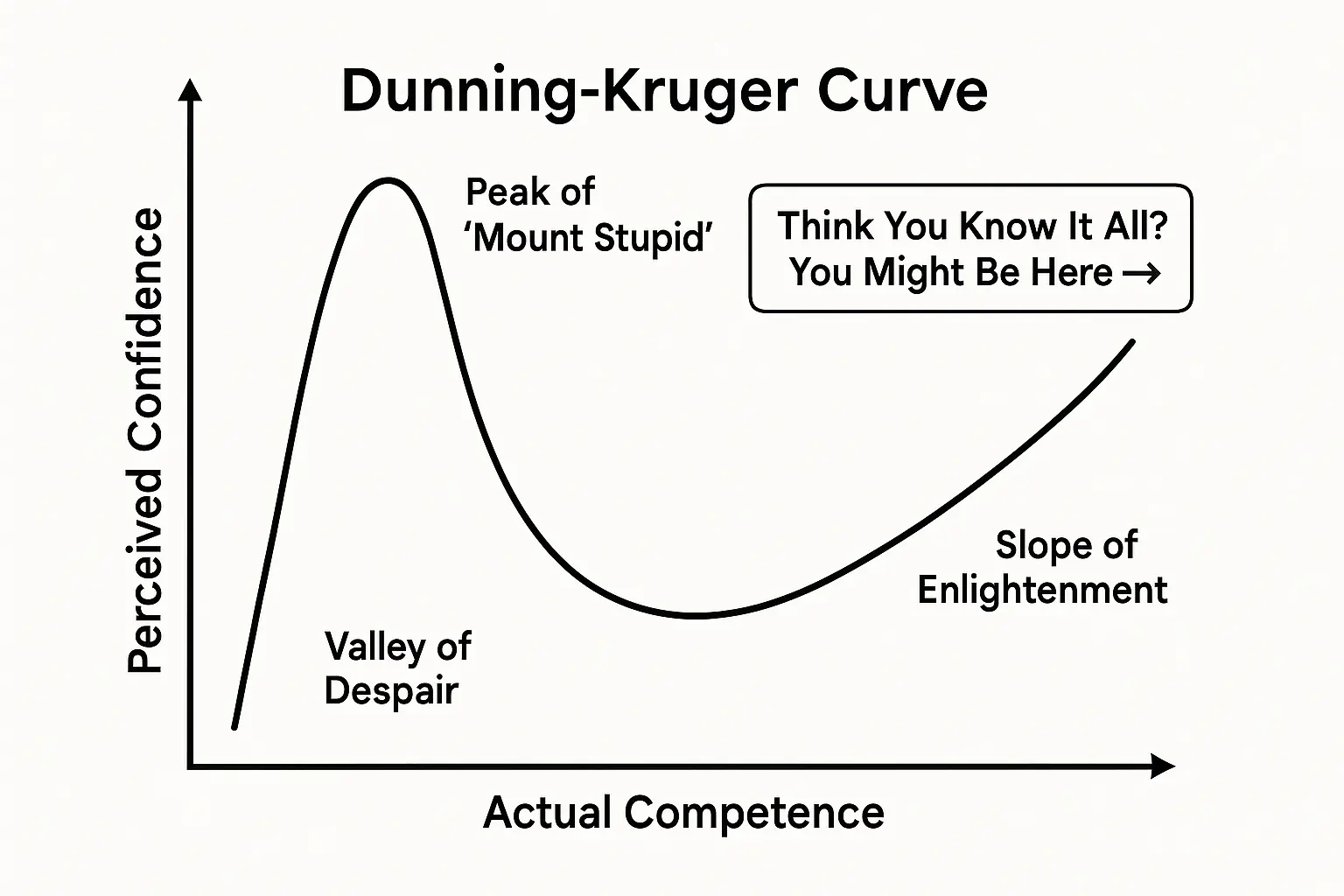
The Dunning-Kreuger Effect is a very eloquent representation of experience and perceived intelligence regarding a topic area or subject matter.  It is “a cognitive bias in which people mistakenly assess their cognitive ability as greater than it is.”

source: https://evidenceinmotion.com/goodharts-law-the-cobra-effect-and-dunning-kreuger/

The concept of the Dunning-Kruger effect is based on a 1999 paper by Cornell University psychologists David Dunning and Justin Kruger. The pair tested participants on their logic, grammar, and sense of humor, and found that those who performed in the bottom quartile rated their skills far above average. For example, those in the 12th percentile self-rated their expertise to be, on average, in the 62nd percentile. 

source: https://www.psychologytoday.com/us/basics/dunning-kruger-effect


Saturday, August 14, 2021

Saturday, April 24, 2021

Organizational Entropy


Having people chip in on work beyond their normal responsibilities leads to situations where it’s not clear who owns what decisions. When someone wants to make a change, they’ll likely pull in all the people who have contributed to discuss the history and decisions that went into the design. Because they have all the history, they’ll likely join to discuss the next change too. And the next change. And the next. People start to lose track of who owns what decisions. When a decision could be anyone’s it becomes no ones. Decision making grinds to a halt.

If unaddressed, this always ends in one of two ways:
  1. No one feels empowered enough to make a decision because they’re afraid of stepping on someone else’s toes (and nothing gets done)
  2. Everyone tries to make the same decision but in opposite directions (and nothing gets done)
In either case, everything starts to feel really hard. Velocity drops to a crawl, the word “consensus” gets thrown around a bunch, and it feels like you’re spending more time talking about decisions than making them.


The root cause of this dynamic is what I call the Law of Organizational Entropy:
Roles and responsibilities drift towards sameness unless acted upon by an opposing force.
Luckily, fighting Organizational Entropy is simple (but not easy). There’s a two-part solution.
The first step is defining how things should work. The second step is finding ways to anchor those ideals to processes and tools.

Step one: Define How you Work

Helping your team understand where it’s going is leadership 101. But Product Visions and North Star Goals are only half of the equation. They show what the team is working towards, but not how they will get there.
 
Teams also need to understand how they should work.
 
Defining and sharing the patterns your teams should use is an organizational superpower. But like any superpower, it can be dangerously misused. When deciding which ideals to define be very careful. If you pick the wrong parts of your process to standardize or standardize too much or too little then it can do more harm than good.
  • Standardizing bad practices hobbles growth. 
  • No structure is chaos.

  • Too much structure is suffocating.
It can be hard to tell from afar if your guidelines are helpful or harmful. But the teams who live with them can absolutely tell you. Talk to your teams regularly about whether the ideals you’re aiming for feel right or if they need an update.

Step Two: Finding Anchors

On of my favorite examples of a leader finding elegant anchors comes from Facebook. When Mark Zuckerberg got up on stage in front of the company and declared that they were going ‘mobile first’ he expected mountains to move. But weeks later nothing had happened. He was still in the same meetings listening to the same people talk about the same (desktop) things. Saying you want something to change is almost never enough to actually make it happen — even for billionaire CEOs. Faced with that reality, Zuckerberg decided to make a drastic change.
 
He announced that from that day on he wouldn’t sit in another meeting, listen to a single idea, or look at a single prototype that wasn’t for mobile. He lived up to his promise and wiped his calendar clean. As you might imagine, chaos ensued. It turns out the CEO refusing to take your meeting is a pretty strong motivator. By the end of the week his calendar started filling back up. Miraculously, every meeting was about mobile.Within a couple of months the company focus had totally shifted. He found a way to anchor the change he wanted into the routines of the company and got dramatic results. Zuckerberg’s anchor point was his calendar but there are plenty of other options.

Every organization has routines, cadences, and rhythms that govern how the company works. Maybe it’s a monthly meeting or a daily standup. Maybe it’s a weekly email update or a quarterly business review. Regardless of the specifics, finding a way to hook into those routines is a critical piece of making your ideals stick. Successful anchors make it easier to work in the “right” way than the “wrong” way.

Want to encourage teams to do more user research? Great! Schedule a recurring meeting with their boss’s boss to review the latest results. You’ll have user research happening left and right.
Want to change how your company discusses goals? Great! Add a Goals section to the budget request template. Reject any that don’t have it completed to your (public) standards. Everyone’s goals will be spotless.

Finding a way to build anchor points within an organization is incredibly important but it can be hard to find the right place to start. As a first step, think about where functional areas or leadership levels overlap. Consider the times when managers talk to reports or when one group talks to another. Those places tend to have meetings, routines, and formalized pathways of communication. Intercepting and modifying those flows of information can be a great leverage point for change.

Fighting Organizational Entropy is tough. It’s a naturally occurring byproduct of every company and the faster you grow the more pronounced it’s effect becomes. But with some careful thought and precise action you can keep Organizational Entropy in check and keep your company moving forward.